The Definitive Guide to Automated Bank Reconciliation Statement (BRS) Generation for High-Volume Enterprises
Gaurav Singhal
View LinkedInFor enterprise finance teams, month-end closing is often defined by a familiar, stressful ritual: bank reconciliation.
In a high-growth company, matching cash flows between bank accounts and general ledgers is a massive operational hurdle. As transaction volumes surge, treasury managers find themselves buried under spreadsheets, spending days manually pairing records.
Recently, we rolled out a next-generation Bank Reconciliation Statement (BRS) engine designed to solve this exact headache. The results show the power of smart automation: our engine achieved a 97% match rate, reconciling ~7,000 bank statement transactions against a pool of ~23,000 ERP ledger entries in under a minute.
Here is a look at the business problem, why it is so difficult to solve manually, and how Ambill transforms month-end treasury into a one-click operation.
The Strategic Importance of BRS
At its core, bank reconciliation seems simple: verify that the money entering or leaving your bank accounts matches the transactions recorded in your books.
However, for a scaling enterprise, bank reconciliation is the foundation of working capital management, cash visibility, and audit compliance. When done manually, it is a silent operational bottleneck that slows down month-end closings, increases audit risk, and locks up valuable finance talent in administrative data entry.
1. The Challenges We Solve
When a company operates at scale, the treasury matching process encounters significant real-world friction:
A. Fragmented Bank Portals and ERP Entities
Enterprises manage cash across multiple global banks, dozens of bank accounts, and diverse international currencies. Gathering these transaction feeds, standardizing raw bank descriptions, and mapping them to their corresponding entities in the ERP (such as Microsoft Dynamics 365, NetSuite, or SAP) is a chaotic manual process.
B. The Invoice Matching Backlog (AR/AP Allocations)
Customers frequently bundle payments for multiple invoices into a single bank transfer. On the bank statement, this shows up as a single, consolidated receipt, while the ERP has separate, individual invoice lines. Reconciling these bundled transactions manually requires accounting teams to spend hours tracking down remittances and piecing together payments.
C. Downstream Clearing Discrepancies
Bank transactions rarely clear in a vacuum. Differences due to currency exchange rate fluctuations, processing fees (like Stripe or gateway charges), and bank service commissions create discrepancies between what is recorded in the ledger and what appears on the bank statement. Identifying and adjusting these differences line by line is slow and prone to errors.
2. The Ambill Solution: Automated Treasury Orchestration
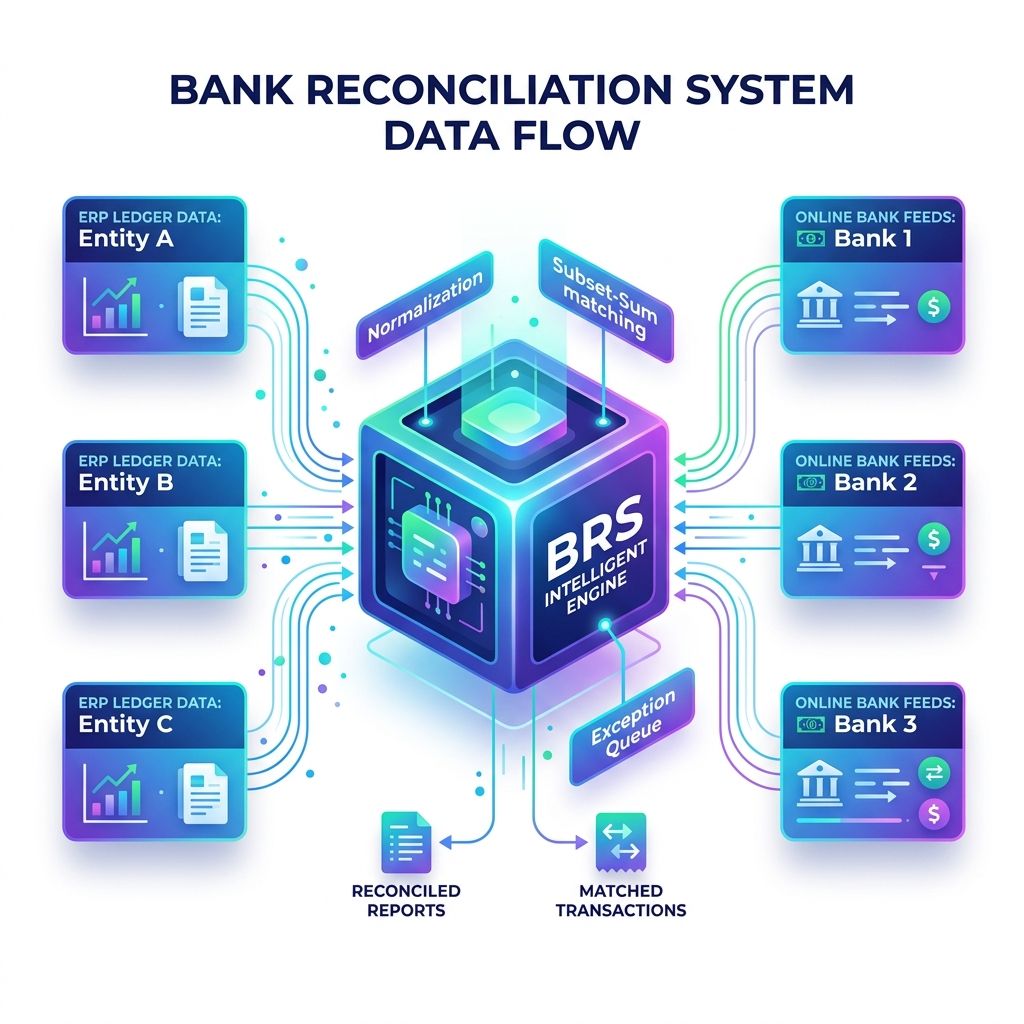
Ambill acts as the automated orchestration layer between your global bank feeds and your ERP ledger. Rather than asking accountants to match transactions manually, Ambill automates the ingestion, matching, and report generation processes.
Ingest and Standardize
Ambill automatically retrieves bank statement feeds and standardizes diverse formats (such as BAI2, MT940, CAMT, or custom spreadsheets) into a unified dataset, aligning dates and amounts instantly.
Intelligent Matching & Grouping (How It Works)
Rather than relying on basic, rigid 1-to-1 lookups, Ambill employs a multi-pass matching strategy that mimics the logical steps of a senior treasury accountant:
- High-Confidence First: The engine first scans both datasets to lock down exact matches by standardized transaction references and UTR codes.
- Automated Split-Payment Solver: To resolve the invoice matching backlog, the engine uses a specialized grouping solver. If a customer paid for three separate orders in a single bank wire, the solver automatically calculates which combination of invoices sums up to the cleared amount.
- Timeline Fallbacks: For transactions lacking explicit reference numbers (such as cash deposits or manual clearings), the engine falls back to daily aggregation checks.
Automated Exception Handling
For entries where balances differ due to exchange rates, gateway service fees (like Stripe charges), or bank commissions, Ambill isolates the discrepancy and routes the transaction to an exception queue. This gives treasury managers immediate visibility to review and post adjustments directly, without wasting hours searching for mismatches.
3. Business Impact: Why It Matters for the Bottom Line
Moving from manual spreadsheets to Ambill changes the dynamics of corporate finance in several key ways:
- Fast Month-End Closings: Instead of taking days or weeks to close the books, treasury teams can reconcile accounts in under 60 seconds. This allows leadership to access accurate financial reports and make strategic decisions much faster.
- One-Click BRS Generation: Ambill dynamically generates a complete, formatted Bank Reconciliation Statement (BRS) report. This document shows exactly how the ERP ledger balances tie back to the bank statement (reconciling uncleared cheques, deposits in transit, and adjustments) and is ready for executive sign-off.
- Treasury and Working Capital Clarity: By immediately identifying which customer receipts have cleared without being allocated to invoices, companies can reduce their Day Sales Outstanding (DSO) and optimize working capital.
- Audit-Ready Transparency: The system automatically links bank transactions to their ERP ledger entries, creating a clean, searchable audit trail that simplifies compliance and meets internal control requirements (such as SOX).
- Focus on Strategy, Not Data Entry: Finance teams spend their time resolving true anomalies rather than performing repetitive lookup tasks.
Elevating Treasury Operations
By automating data ingestion, matching, and report generation, Ambill turns bank reconciliation into a streamlined, one-minute process. This allows high-volume enterprises to scale their finance operations efficiently, protect against audit risks, and gain clear visibility into cash positions.
Ready to modernize your treasury operations? Discover how Ambill can automate your BRS workflows today.